
The 2024 energy performance certificate – what you absolutely need to know
14. December 2023

Anyone looking to buy or rent a property these days will notice a particularly striking letter with a colorful border on every exposé. The letter is not only decorative, but also contains important information on energy efficiency and is part of the energy performance certificate.
The reason for this is Section 79 of the Building Energy Act (GEG), which stipulates that an energy certificate must be issued for buildings. This certificate is valid for ten years and is particularly relevant if a property is to be sold, rented or leased.
But what does the energy performance certificate actually mean, is it important and what are the differences between the demand and consumption certificates?
Why do you need an energy performance certificate?
The energy performance certificate serves as a source of information for potential buyers, tenants or leaseholders. Its task is to provide information about the energy performance and the associated greenhouse gas emissions of a building. This enables interested parties to assess the energy efficiency of a property and, if necessary, plan measures to improve the energy balance.
The types of energy certificate
There are two main types of energy performance certificate: the consumption certificate and the demand certificate.
The consumption certificate refers to the actual energy consumption of a building. It is based on the heating costs and consumption bills for the last three years. Even if it is difficult to imagine, the consumption certificate can be used for unoccupied buildings. In this case, other values such as lighting, ventilation and cooling are included. The certificate is inexpensive to produce, but carries the risk that economical user behavior will have a positive effect on the energy status of the building, even though it may not be energy efficient.
In contrast, the requirement certificate focuses on the building structure and fabric of a building as well as the system technology. Information on the roof, windows, insulation, heating system and more is analyzed using mathematical formulas. Recent improvements are taken into account in the requirement certificate and planned measures can easily be included in an updated certificate. The preparation of the requirement certificate is significantly more expensive than the consumption certificate, as it can be very time-consuming depending on the building structure. One advantage of the requirement certificate is that the energy efficiency cannot be manipulated by economical user behavior as with the consumption certificate. However, the quality of the information depends heavily on the accuracy of the issuer.
Which energy certificate do I need?
Many owners assume that it is up to them which energy performance certificate they apply for.
However, this assumption is not entirely correct. In general, owners are free to decide for all properties, except for residential buildings with up to 4 residential units that were built before 01.11.1977.
See table.

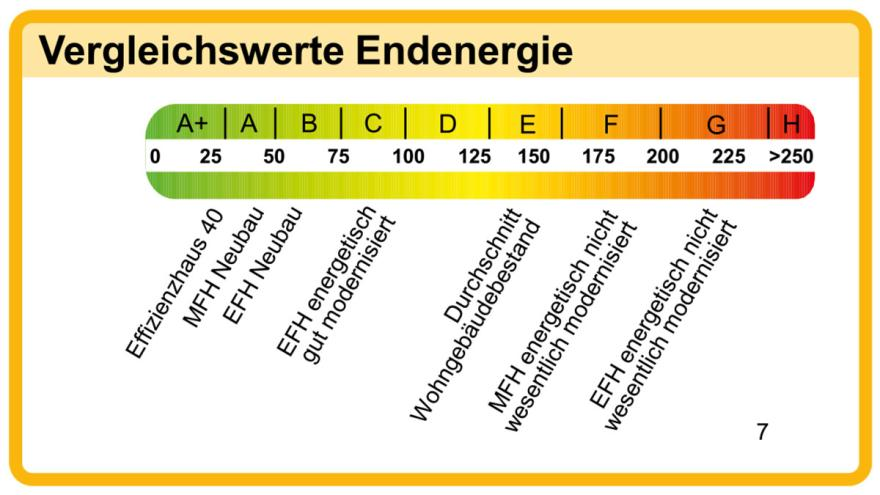
The comparative values for final energy
A central element of every energy performance certificate is the “comparative final energy values” scale.
After the inspection, each energy performance certificate is given a letter from this scale, which represents the conclusion about the energy efficiency of the property.
The rule is: the further forward in the alphabet, the more energy-efficient the property is.
This letter scale provides a simple guide for interested parties to determine the energy performance of a building at a glance and, if necessary, to compare it with other buildings.
Even if opinions on energy performance certificates are very divided, at a time when environmental awareness and energy efficiency are becoming increasingly important, the energy performance certificate acts as a guide to transparent information on the energy status of buildings. Anyone who buys, rents or leases a property should therefore be aware that the energy performance certificate is not only a legal obligation, but also an important information tool for a sustainable real estate industry.
Sources:
- https://www.energieausweis-to-go.de/energieausweise-online/
- https://www.verbraucherzentrale.de/wissen/energie/energetische-sanierung/energieausweis-was-sagt-dieser-steckbrief-fuer-wohngebaeude-aus-24074
- https://energieausweis.de/blog/der-unterschied-zwischen-verbrauchsausweis-und-bedarfsausweis/?gad_source=1&gclid=EAIaIQobChMIxtiu_vDoggMViZFQBh1bVAvuEAAYAiAAEgLtAPD_BwE
- https://www.gesetze-im-internet.de/geg/__79.html
More articles from Maile Immobilien
News
Nina Weikmann in an interview with Nadja Gontermann from Antenne 1 – tips for finding accommodation
Tipps & Tricks
Most people who have ever looked for an apartment in Stuttgart know how tough the process can be. It is either difficult to get a viewing appointment or to be selected as a new tenant. Last May, our real estate agent Nina Weikmann surprisingly gave an interview to Nadja Gontermann from Hitradio Antenne 1. Hitradio…
Read more
“You have to know how to be lucky!” Our Managing Director Michael Maile in an interview with Johannes Wosilat from The Hidden Champion
Uncategorized
Last summer, Johannes Wosilat from the podcast and video format "The Hidden Champion" and our boss Michael Maile met in the cozy atmosphere of our office for a not entirely private one-on-one conversation. Johannes uses his format to shed light on the people who achieve great things in their industry day in, day out and…
Read more
Energy-efficient renovation roadmap 2024! Our guide to saving costs & protecting the environment
Uncategorized
General information on the topic of renovation roadmaps The topic of energy-efficient refurbishment is currently becoming increasingly important. This can be attributed both to the effects of climate change and the associated concept of sustainability, as well as to the energy crisis, which has led to a rapid rise in energy prices. Energy refurbishment refers…
Read more